
Covered calls are one of the most established options-based investment strategies, dating back to the introduction of listed options in the 1970s. Over the decades, they have remained popular because of their straightforward premise: generating option premium from stocks an investor already owns. The strategy generally involves trading some potential future gains for cash received at the time the option is sold. To understand how covered calls work in practice, it helps to break the strategy down into its basic components.
The Core Idea
A covered call strategy combines two core positions:
- Owning a stock
- Selling a call option on that same stock
By selling the call option, the investor receives cash up front, known as the option premium. In exchange, the investor agrees to sell the stock at a predetermined price (the “strike price”) if the option is exercised.
Because the stock is already owned, the obligation from selling the call is fully “covered”.
When Covered Calls Work and When They Don’t
Covered calls are often described as being most aligned with markets where stock prices are flat or rise gradually. In those environments, an investor may collect option premiums while still participating in some of the stock’s upside.
If stock prices rise sharply, gains above the strike price may be limited. If stock prices fall, the investor’s stock position value declines, and the premium collected may provide only limited offset. Outcomes can vary meaningfully based on factors such as the strike price selected, time to expiration, volatility, and transaction costs.
A Simple Covered Call Example
Let’s walk through a simple example: assume a stock is trading at $100, and an investor sells a call option with:
- Strike price: $105
- Premium received: $3
The investor immediately collects $3 in cash. That premium is received upfront and does not depend on what happens to the stock afterward.
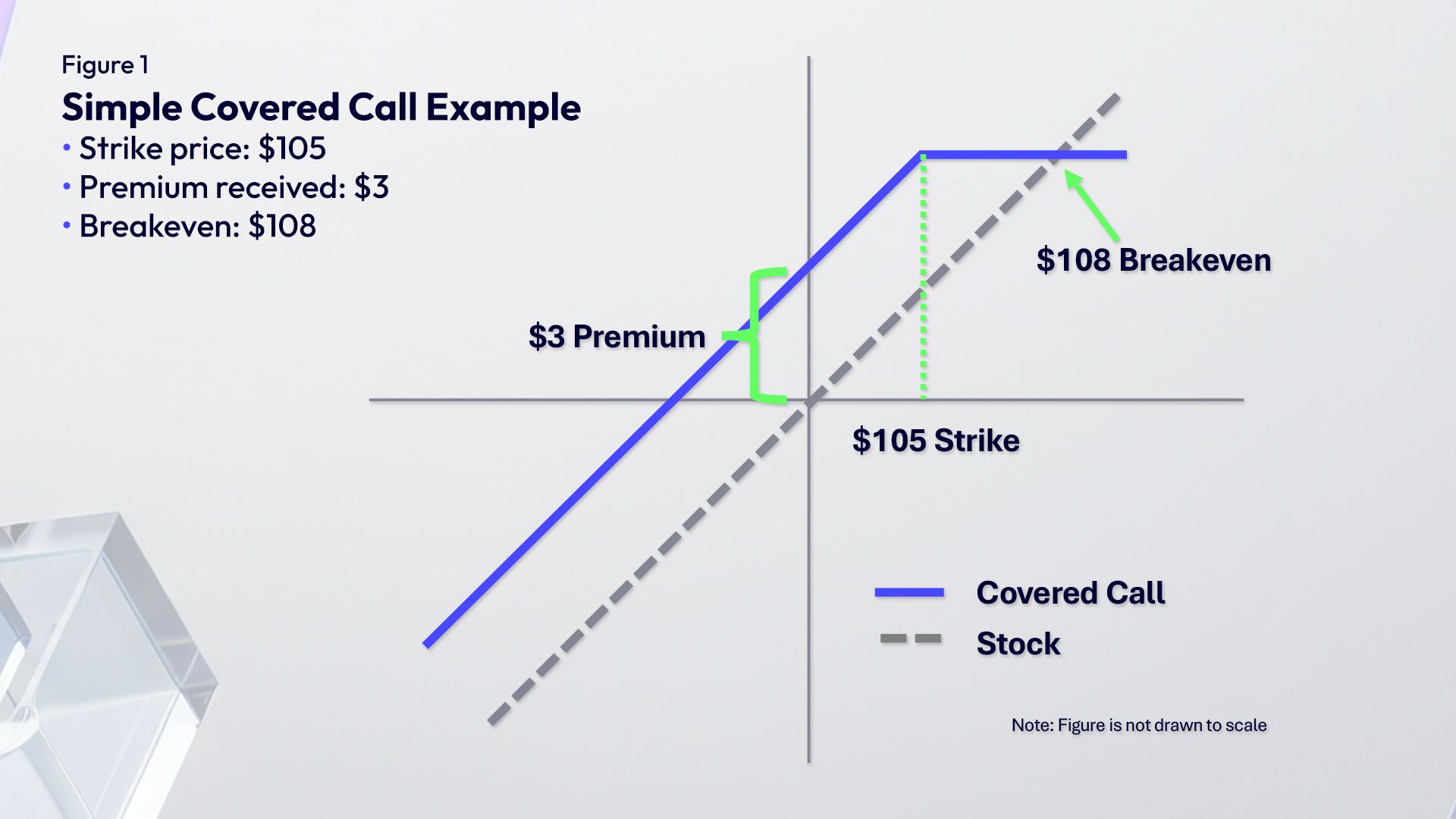
Now, the covered call has four possible outcomes at expiration:
- The Stock Falls
If the stock falls to $90, the call option expires worthless.
The investor ends up with stock worth $90 and keeps the $3 premium, resulting in a total value of $93. While the stock has declined, the covered call investor is better off than simply holding the stock, thanks to the premium collected.
- The Stock Is Flat
If the stock finishes at $100, the call option again expires worthless.
The investor keeps the stock and the $3 premium, ending with a total value of $103. In this scenario, the covered call strategy outperforms owning the stock alone, as the premium becomes incremental return.
- The Stock Rises to the Strike Price
If the stock rises to $105, the call option is exercised.
The investor sells the stock at $105 and keeps the $3 premium, for a total value of $108. This is the optimal outcome for a covered call strategy — it captures the maximum upside and all the premium.
- The Stock Rises Above the Strike Price
If the stock rises beyond $105, the call option is exercised and the stock is still sold at $105.
The investor’s total return remains $108, meaning gains are capped at $8. Any upside beyond that level is given up in exchange for the premium collected at the start of the strategy.
This outcome highlights the central trade-off of covered calls: income in exchange for limited upside.
Examples do not include fees and expenses. Tax implications are not considered in the examples above.
How Investors Use Covered Calls
Investors use covered calls in several ways, depending on their goals and constraints.
A common use is to generate option premiums, which may provide a source of cash flow over time. Another use is that the premium may partially offset modest declines in the underlying stock price, though it does not eliminate downside risk. Covered calls are also sometimes used as a portfolio management tool, because the sold call option can change the portfolio’s return profile relative to holding the stock alone.
It’s important to note that these potential characteristics come with trade-offs, and results depend on market conditions and implementation details.
Covered Calls in ETFs: A Growing and Innovative Space
Covered call strategies have become increasingly accessible through exchange-traded funds (“ETFs”). These ETFs typically combine an equity portfolio (or index exposure) with a systematic process for selling call options and periodically “rolling” those options over time.
ETFs can simplify access by packaging option execution and ongoing management inside a fund structure. However, ETF implementation details matter, including option coverage level, strike selection, roll schedule, fees and expenses, tax considerations, and the possibility that distributions may vary over time and can include return of capital.
Today’s covered call ETFs span a wide range of approaches, with ongoing innovation in how options are selected, managed, and combined with underlying equity exposure. As a result, investors can access the strategy in different ways depending on their objectives and risk tolerance.
Final Thoughts
Covered calls are a long-standing strategy that combines equity exposure with option premium. While the strategy can limit participation in high upside scenarios, it also leaves investors exposed to downside moves in the underlying stock, with the premium providing only limited offset in some cases. Covered calls can meaningfully change how equity risk is experienced over time, and outcomes will vary across different market environments and implementations.
This content is intended for educational purposes only. It does not constitute investment advice or an offer or solicitation and should not be used as the basis for any investment decision. No tax advice is provided herein; investors should consult tax advice regarding tax implications of any investment strategy. Options involve risk and are not suitable for all investors.
Carefully consider the Funds’ investment objectives, risk factors, charges and expenses before investing. This and additional information can be found in the Funds’ Prospectus and Summary Prospectus, which may be obtained by visiting www.xETFs.com/investor-materials. Read the Prospectus and Summary Prospectus carefully before investing.
Exchange Traded Concepts, LLC serves as the investment adviser. WallStreetX ETFs, Inc. dba xETFs serves as the sub-adviser. The Funds are distributed by Foreside Fund Services, LLC., which is not affiliated with xETFs, Exchange Traded Concepts, LLC, or any of its affiliates.
Investing involves risk, including possible loss of principal. The Fund’s return may not match or achieve a high degree of correlation with the return of the Index. To the extent the Fund’s investments are concentrated in or have significant exposure to a particular issuer, industry or group of industries, or asset class, the Fund may be more vulnerable to adverse events affecting such issuer, industry or group of industries, or asset class than if the Fund’s investments were more broadly diversified. Issuer-specific events, including changes in the financial condition of an issuer, can have a negative impact on the value of the Fund.
A new or smaller fund is subject to the risk that its performance may not represent how the fund is expected to or may perform in the long term. In addition, new funds have limited operating histories for investors to evaluate and new and smaller funds may not attract sufficient assets to achieve investment and trading efficiencies.
Shares are bought and sold at market price (closing price) not net asset value (NAV) and are not individually redeemed from the Fund. Market price returns are based on the midpoint of the bid/ask spread at 4:00pm Eastern Time (when NAV is normally determined) and do not represent the return you would receive if you traded at other times. Brokerage commissions will reduce returns.