5-minute read

The AI boom has a lot of potential winners. OpenAI. Google. Microsoft. Tesla. Each is building something significant. But behind all of them is one shared requirement: massive computing power.
Training and running modern AI models requires billions of dollars in infrastructure. Data centers full of specialized chips. And one company supplies the engine for most of it: NVIDIA.
1. NVIDIA Owns the AI Infrastructure Layer
If AI is the gold rush, NVIDIA makes the picks and shovels.
The company is estimated to control roughly 80% to 90% of the market for AI accelerator chips. These are the processors that train and run large language models, powering everything from ChatGPT to enterprise software to autonomous vehicles.
Source: NVIDIA public statements and third-party industry estimates, including reporting from The New York Times (2025), on NVIDIA’s share of the AI accelerator/GPU market used to train and deploy AI models. Estimates vary by source and may change over time.
That dominance is not just about hardware. NVIDIA's CUDA software platform has become the standard toolkit for AI developers worldwide. Switching away from it is technically possible, but it's expensive, slow, and rarely worth it. That creates a structural moat that reinforces NVIDIA's position every time a new developer builds on it.
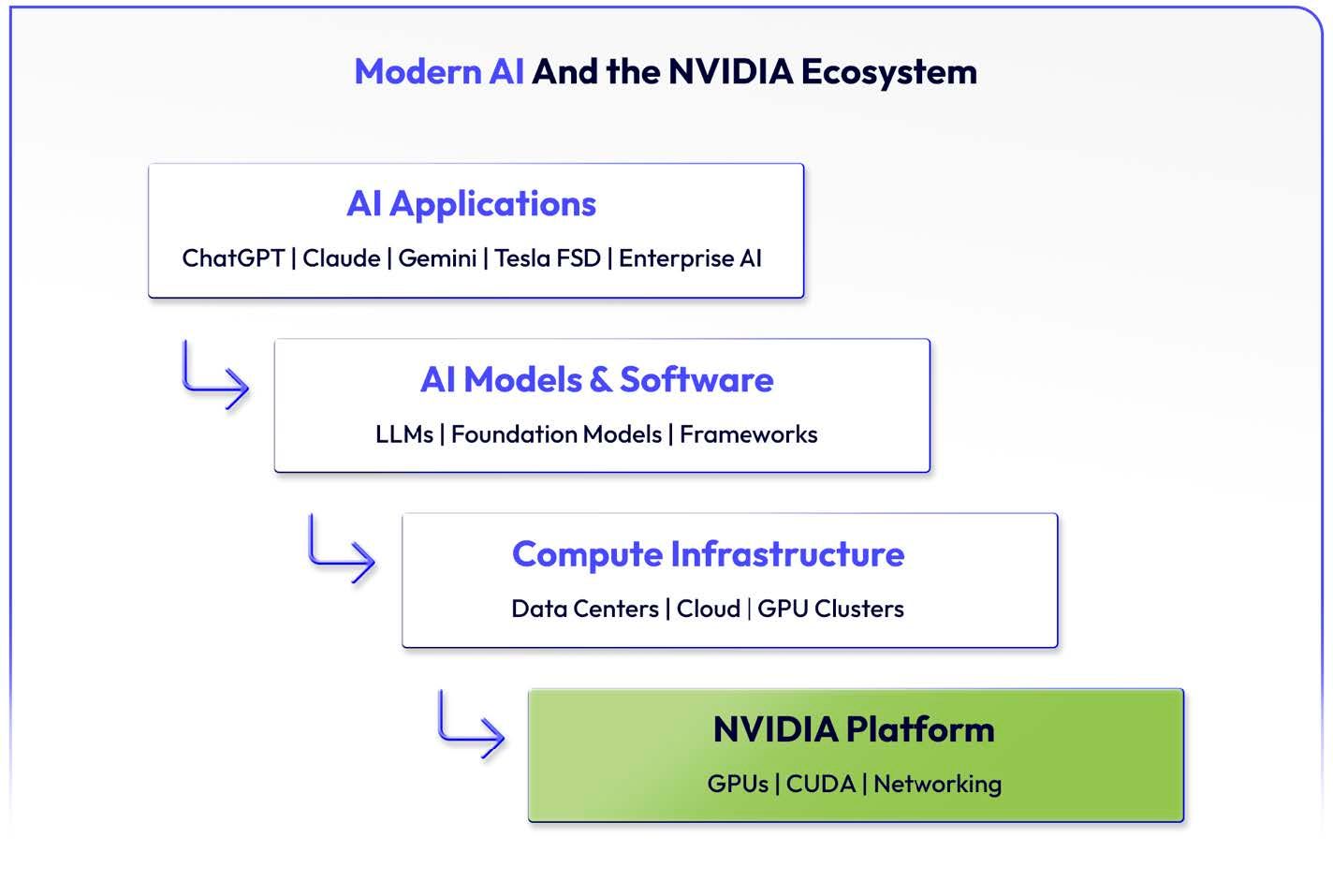 Source: xETFs. Diagram is illustrative of the AI compute stack and is not based on third-party market data.
2. The Numbers Back It Up
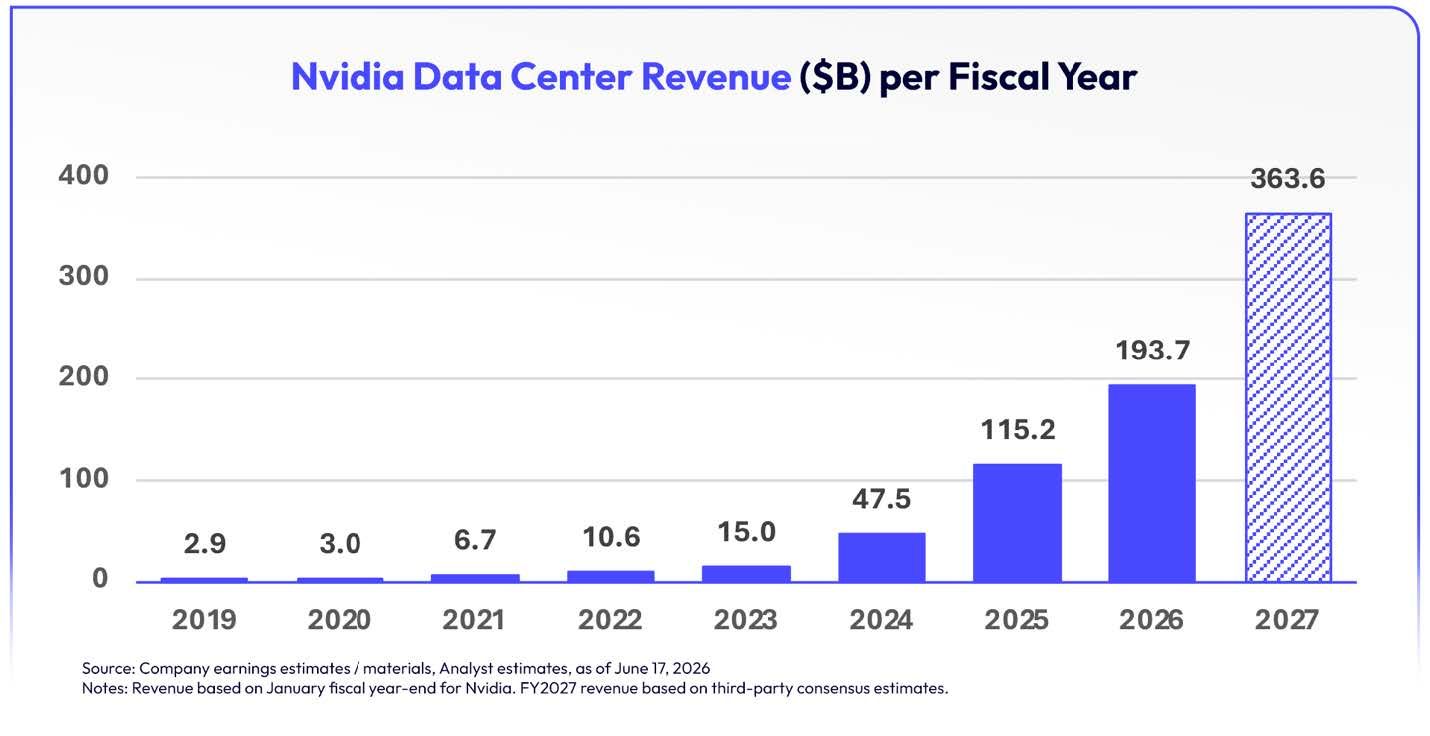
NVIDIA's data center revenue has gone from roughly $3 billion in fiscal year 2019 to nearly $200 billion in fiscal year 2026.1
Analysts estimate it may grow another 88% to roughly $364 billion in FY2027.2
The driver? The largest technology companies in the world are in an all-out race to build AI infrastructure. Microsoft, Amazon, Google, and Meta are expected to spend over $600 billion combined on data centers and AI in 2026 alone. A significant share of that spending runs directly through NVIDIA.
3. It's More Than Just Chips
NVIDIA isn't selling one product. It's building the full artificial intelligence stack:
- High-speed networking (InfiniBand and NVLink) that connects thousands of GPUs across large AI clusters
- The CUDA software platform, used by millions of developers to build and deploy AI applications
- Autonomous driving systems used by Mercedes-Benz, Toyota, and General Motors
- Gaming GPUs, where NVIDIA still holds over 90% of the discrete desktop GPU market
Each of these is a meaningful business on its own. Together, they reinforce each other and extend NVIDIA's reach well beyond any single product cycle.
1 Source: NVIDIA quarterly and annual earnings releases and SEC filings (investor.nvidia.com), including the company’s fiscal 2026 fourth-quarter earnings release (Feb. 25, 2026), which reported full-year Data Center revenue of $193.7 billion.
2 Third-party analyst consensus estimate, not a company forecast, and is subject to change; see chart below for additional detail.
| Want Exposure to NVIDIA With the Potential for Daily Income? |
|
The xETFs NVDA Daily Income ETF (NYYY) is designed to provide long exposure to NVDA while seeking to generate |
4. NVIDIA Is Investing in the AI Future
NVIDIA isn't just supplying the AI industry. It's actively building it.
The company has committed $30 billion to support OpenAI's next-generation AI development and invested $2 billion each in CoreWeave and Nebius, two of the fastest-growing AI infrastructure providers. It has also backed a range of partners across the AI supply chain, including Lumentum, Marvell, Coherent, and others.
These investments are designed to accelerate AI development broadly, while keeping NVIDIA at the center of the ecosystem that may benefit most from that acceleration.
5. A Chip Roadmap Built Like an Upgrade Cycle
Under CEO Jensen Huang, NVIDIA's hardware roadmap has become relentless. Each new generation of chips delivers meaningful improvements in performance and efficiency.
NVIDIA Data Center GPU Architectural Generations:
- Hopper → Blackwell → Vera Rubin (most recent)
Think of it like Apple's annual iPhone upgrade cycle, but for AI infrastructure. Each new generation drives demand for more powerful systems, and companies that want to stay competitive keep buying in.
NVIDIA is also pushing AI beyond the data center. New products like RTX Spark are designed to bring frontier AI models directly to personal computers, with the goal of putting AI not just in. corporate data centers, but on every desk.
The Opportunity Ahead
The AI build-out is still in its early stages. As more industries adopt AI and models become more capable, the demand for compute is expected to keep growing. From software and enterprise systems to robotics and autonomous vehicles, AI is becoming more embedded in everyday life, and the need for computing power will only continue to grow.
At the center of it all is NVIDIA.
Investing in NVIDIA? There may be a way to do it with daily potential income.
For investors seeking exposure to NVIDIA alongside daily potential income, the xETFs NVDA Daily Income ETF (NYYY) is designed to provide long exposure to NVDA while seeking to generate daily potential income through a systematic daily options strategy. The fund seeks to retain the majority of NVIDIA's upside, with the goal of providing both equity participation and income generation from one of the market's most closely watched stocks, with weekly distributions.
All fund materials, including the prospectus, are available at xETFs.com/investor-materials.
Carefully consider the Funds’ investment objectives, risk factors, charges and expenses before investing. This and additional information can be found in the Funds’ Prospectus and Summary Prospectus, which may be obtained by visiting www.xETFs.com/investor-materials. Read the Prospectus and Summary Prospectus carefully before investing.
Exchange Traded Concepts, LLC serves as the investment adviser. WallStreetX ETFs, Inc. dba xETFs serves as the sub-adviser. The Funds are distributed by Foreside Fund Services, LLC., which is not affiliated with xETFs, Exchange Traded Concepts, LLC, or any of its affiliates.
Investing involves risk, including possible loss of principal. The Fund’s return may not match or achieve a high degree of correlation with the return of the Index. To the extent the Fund’s investments are concentrated in or have significant exposure to a particular issuer, industry or group of industries, or asset class, the Fund may be more vulnerable to adverse events affecting such issuer, industry or group of industries, or asset class than if the Fund’s investments were more broadly diversified. Issuer-specific events, including changes in the financial condition of an issuer, can have a negative impact on the value of the Fund.
A new or smaller fund is subject to the risk that its performance may not represent how the fund is expected to or may perform in the long term. In addition, new funds have limited operating histories for investors to evaluate and new and smaller funds may not attract sufficient assets to achieve investment and trading efficiencies.
Shares are bought and sold at market price (closing price) not net asset value (NAV) and are not individually redeemed from the Fund. Market price returns are based on the midpoint of the bid/ask spread at 4:00pm Eastern Time (when NAV is normally determined) and do not represent the return you would receive if you traded at other times. Brokerage commissions will reduce returns.