Artificial intelligence is driving a new semiconductor memory upcycle.
Every AI model runs on semiconductor memory chips. South Korea plays a critical part in this story.
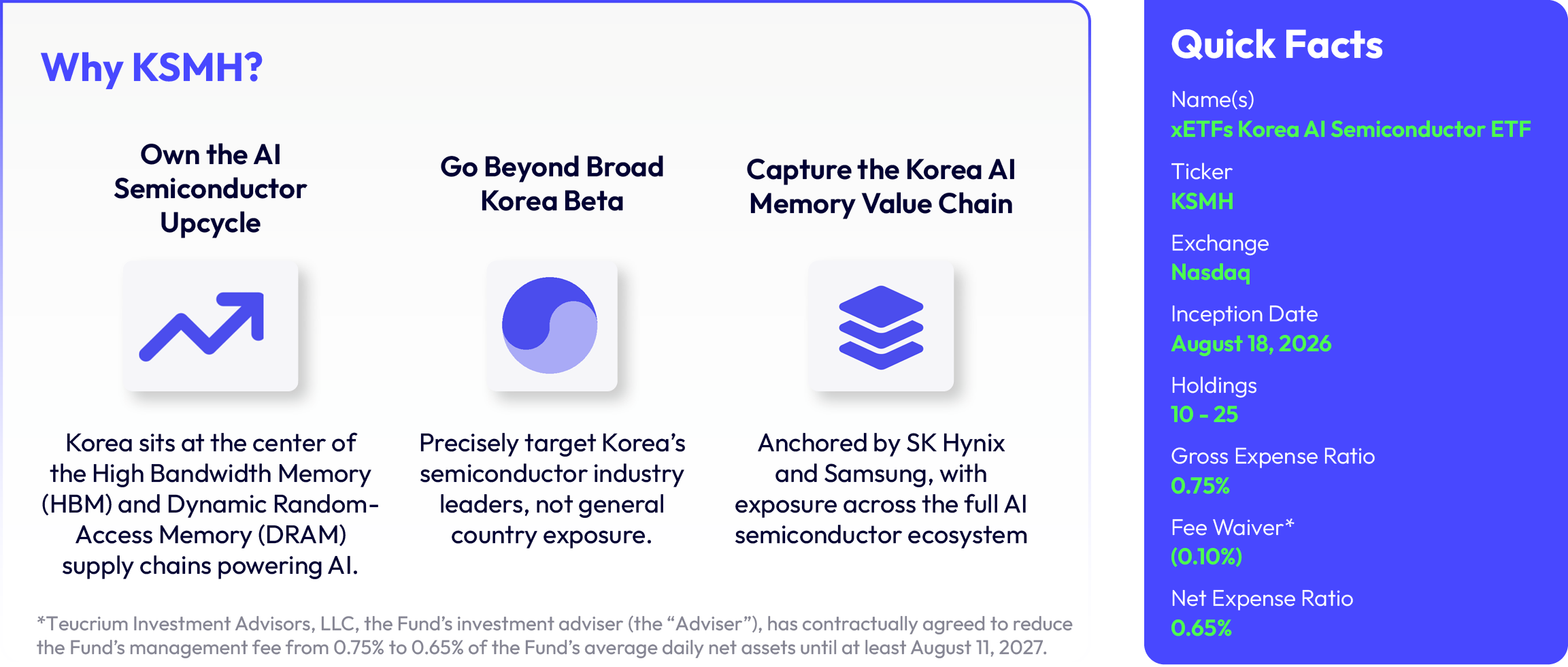
The xETFs Korea AI Semiconductor ETF (Nasdaq: KSMH) is designed to provide investors with focused exposure to a portfolio of Korean companies powering the AI semiconductor value chain – all through a single ticker.
Why Korea Semiconductors?
Memory is one of AI’s key components. Training and running large AI models depends on enormous volumes of data being shuttled between memory and processors. When memory cannot keep pace, the chip remains idle while it waits. This has made High-Bandwidth Memory (HBM) among the scarcest and highest-margin products in the global race to build AI infrastructure.
Driven by the increased demand from the AI boom, the global memory market is projected to more than triple in 2026 (source: TrendForce as of May 2026). The demand may remain elevated well beyond 2026. On its fiscal Q3 2026 earning call, Micron stated that “it does not have line of sight as to when memory supply will be able to catch up with increasing demand.”[1]
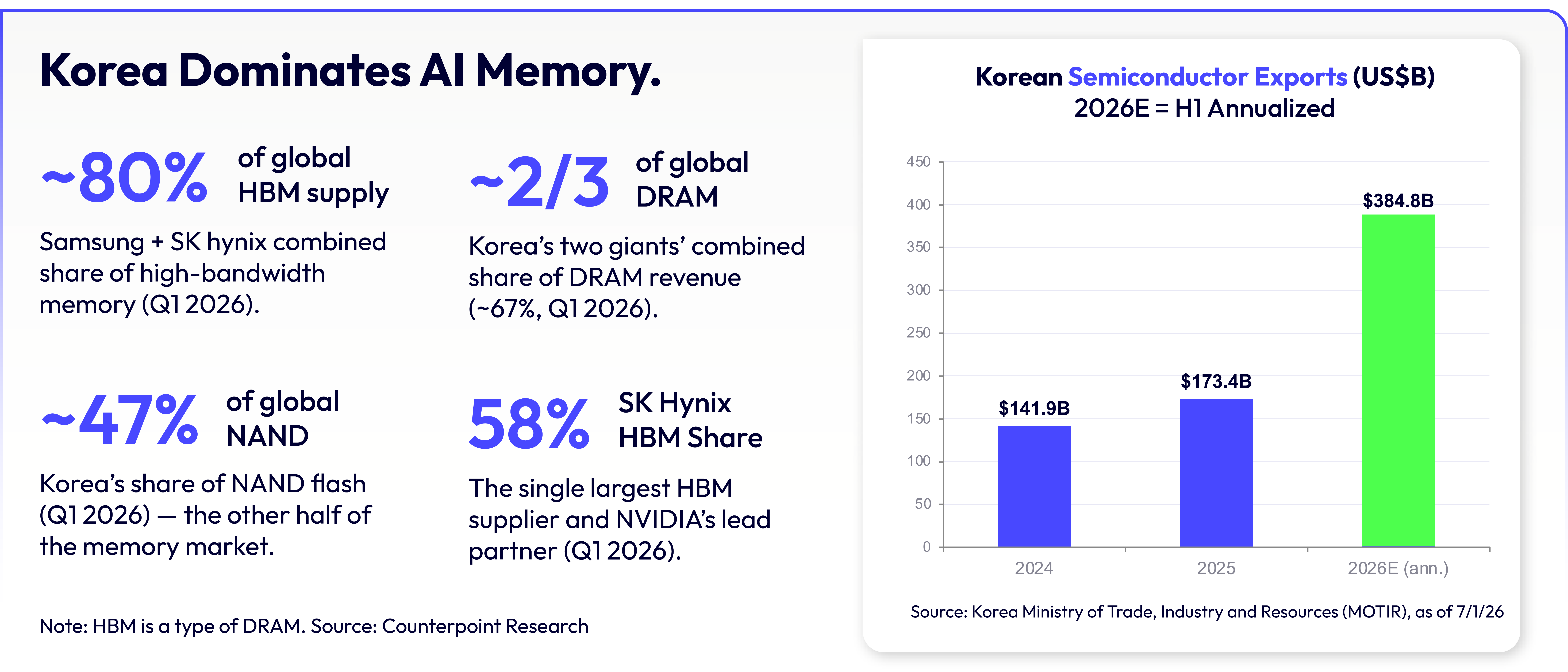
Korea sits at a center of AI memory. South Korea is home to two global leaders in HBM: SK Hynix and Samsung. Together, they represent roughly 80% of global HBM sales as of Q1 2026, with SK Hynix alone representing 58%. And Korea’s leadership extends beyond its two largest memory manufacturers, as the country is also home to companies across the broader semiconductor ecosystem, including
- Advanced packaging and packaging equipment
- Substrates and PCBs
- Semiconductor testing
- Specialty materials
- Wafer fabrication and process equipment
This leadership is reinforced by the Korean government’s strategic commitment to the semiconductor industry. On June 29, 2026, South Korean president Lee Jae Myung called the leaders of Samsung and SK Hynix “national heroes” as his government announced the two companies’ plans to invest [2].[3]
Seoul has further backed the industry with policy initiatives: In 2025, Seoul expanded a financial support package for the semiconductor industry to ₩33T, and increased tax credits on eligible semiconductor facility investments to 20% for large companies and 30% for SMEs.[4] Also in 2025, the government pledged to cover 70% of companies’ costs for underground transmission lines in Yongin and Pyeongtaek, two regions where Seoul is hoping to build “semiconductor clusters.” [5]
KSMH: Focused on Korea. Focused on Semiconductors.
The full Korean AI Semiconductor value chain in one ticker. KSMH spans Korea’s AI semiconductor value chain — from SK Hynix and Samsung, two anchors of the global memory industry, to packaging-equipment makers, substrate and PCB manufacturers, and testing, materials, and equipment companies that keep Korea’s fabs running. Rather than owning just the two headline memory names, KSMH aims to capture the whole ecosystem powering AI.
A fund built for one theme. KSMH is an actively managed ETF listed on Nasdaq that holds a portfolio of 10 to 25 Korean companies spanning the AI semiconductor value chain, with an estimated 20 companies at launch and a 20% cap on any single position.
KSMH provides focused access. Investors seeking exposure to Korea’s semiconductor industry have historically faced limited choices.
Country-focused Korea ETFs spread their exposure beyond semiconductors, including banks, autos, healthcare, and other unrelated sectors. Meanwhile, many semiconductor-focused ETFs are dominated by U.S. and Taiwanese companies.
Buying Korean stocks individually can also be difficult, as many require a foreign brokerage account, currency conversions, and individual trades for each name.
KSMH packages Korea’s AI semiconductor ecosystem into a single U.S.-listed ticker.
Korea Powers AI. Own It.
Artificial intelligence is reshaping the global economy, and Korea is a key center of one of its most important technologies: semiconductor memory. KSMH offers focused exposure to that opportunity - not through broad country or broad semiconductor ETFs, but through a portfolio dedicated to the Korean companies powering the AI semiconductor value chain, including memory, logic, manufacturing and infrastructure.
Learn more and view the prospectus at www.xetfs.com/ksmh
Carefully consider the Fund’s investment objectives, risk factors, charges and expenses before investing. This and additional information can be found in the Fund’s Prospectus and Summary Prospectus, which may be obtained by visiting www.xetfs.com/ksmh Read the Prospectus and Summary Prospectus carefully before investing.
New Fund Risk. The Fund is a recently organized investment company with no operating history. As a result, prospective investors have no track record or history on which to base their investment decision.
Single Country Risk. Because the Fund may invest a significant portion of its assets in companies in a specific country and region, the Fund is subject to greater risks of adverse developments in that country, region and/or the surrounding regions than a fund that is more broadly diversified geographically. Political, social or economic disruptions in the country or region, even in countries in which the Fund is not invested, may adversely affect the value of investments held by the Fund.
Semiconductor Industry Risk. Competitive pressures may have a significant effect on the financial condition of companies in the semiconductor industry. The Fund is subject to the risk that companies that are in the semiconductor industry may be similarly affected by particular economic or market events.
An investment in the fund involves risk, including possible loss of principal. Exchange-traded funds (ETFs) trade like stocks, are subject to investment risk, fluctuate in market value, and may trade at prices above or below the ETF’s net asset value (NAV), and are not individually redeemable directly with the ETF. Brokerage commissions and ETF expenses will reduce returns. ETFs are subject to specific risks, depending on the nature of the underlying strategy of the fund. For a complete description of the fund’s principal investment risks, please refer to the prospectus.
Market figures are third-party estimates and not guarantees of future results. Certain information contained herein has been supplied by third parties. xETFs cannot guarantee the accuracy of any such information and does not represent that such information is accurate or complete.
Teucrium Investment Advisors, LLC serves as the Fund’s investment adviser and WallStreetX ETFs, Inc. DBA xETFs serves as the Fund’s sub-adviser. The Fund is distributed by PINE Distributors LLC, which is not affiliated with Teucrium Investment Advisors, LLC, xETFs, or any of their respective affiliates.
[1] Micron – company earnings call
[3] Source: Reuters
[4] Source: Reuters, Samil PwC
[5] Source: KBS World