
The Bottlenecks Behind the AI Buildout


Artificial intelligence is usually discussed in terms of models and compute. But the harder problem is physical. Before a model can be trained or served, someone has to build the facility that runs it, secure the power to feed it, and manufacture the memory, optics, and silicon inside it. Each of those can carry a lead time, sometimes measured in years.

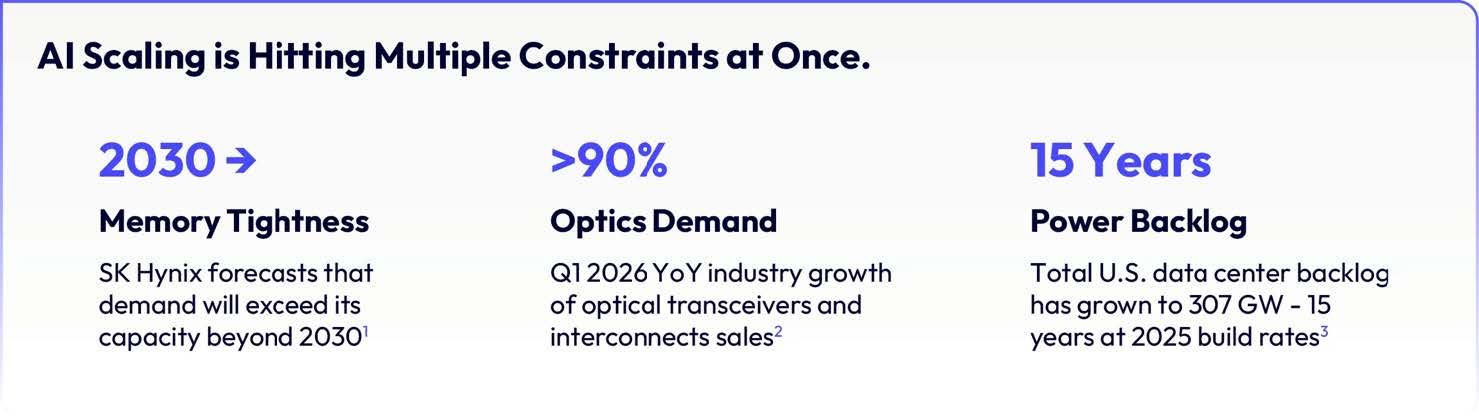
The scale is easiest to see in electricity. On its second quarter 2026 earnings call, Eaton put the U.S. data center industry backlog at 307 gigawatts, roughly 15 years of construction at 2025 build rates.1 In April 2026, GE Vernova told investors it expects its power equipment and services backlog to reach $200 billion in 2027, a year earlier than it had previously indicated.2

Figures like those describe an industrial program rather than a product cycle. Capacity arrives when the slowest input catches up.
 

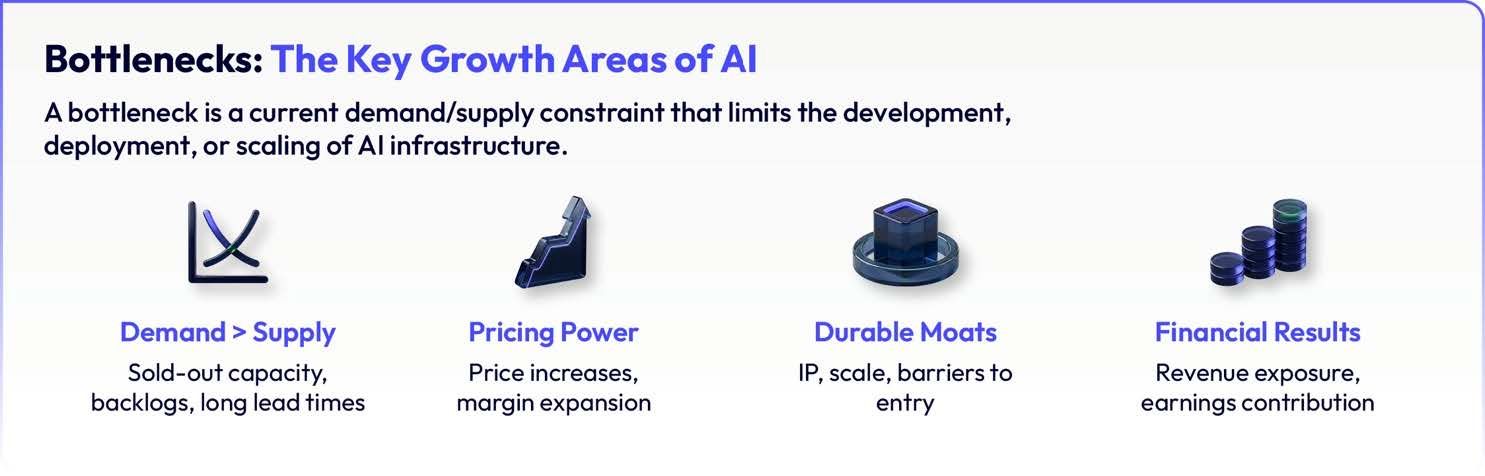
Bottlenecks Defined

In any large construction program, output is governed by the scarcest component rather than the most abundant one. AI infrastructure works the same way, and that is where the investment question narrows. Capital spending is broad, but the leverage concentrates in specific places.

A bottleneck is a current demand and supply constraint that limits the development, deployment, or scaling of AI infrastructure; it reflects today’s shortage.
 

Where We Believe the Constraints Are Today

Memory. Training and serving large models requires moving enormous volumes of data between memory and processors. When memory cannot keep up, the processor waits. That has made high bandwidth memory one of the scarcest inputs in the buildout. In July 2026, SK Hynix CEO Kwak Noh-Jung said, “We still forecast that customer demand will remain higher than our supply capacity even beyond 2030.”3

Optics and networking. Data that leaves one chip has to reach the next. As AI scales, that traffic increasingly moves optically instead of across wires. Sales of optical transceivers and active optical cables were estimated at approximately $10 billion in the first quarter of 2026, more than 90% higher than a year earlier.4

Compute. Orders for AI silicon have been running ahead of what suppliers can deliver. On its second quarter fiscal 2026 earnings call, Broadcom reported more than $30 billion of AI semiconductor bookings against $10.8 billion shipped in the quarter.5

Constraints Can Be Temporary

When a company holds a constraint, it shows up in the numbers: backlogs grow, lead times stretch, and prices rise. That makes future revenue easier to count on.

But that position isn't permanent. Constraints shift as new capacity comes online, substitutes emerge, and spending priorities change. A company that's supply-constrained today may not be tomorrow, so a portfolio built around these companies needs to be able to shift with them.

Introducing NECK

The xETFs AI Bottlenecks ETF (NECK) is an actively managed ETF that seeks to invest in companies we believe are positioned at critical points of constraint across the AI stack, all through a single ticker. Rather than focusing only on the biggest AI companies, NECK looks across the infrastructure required to build and scale AI for areas where demand may be growing faster than supply or where companies hold critical strategic positions.

The portfolio is expected to generally include between 15 to 25 companies globally.
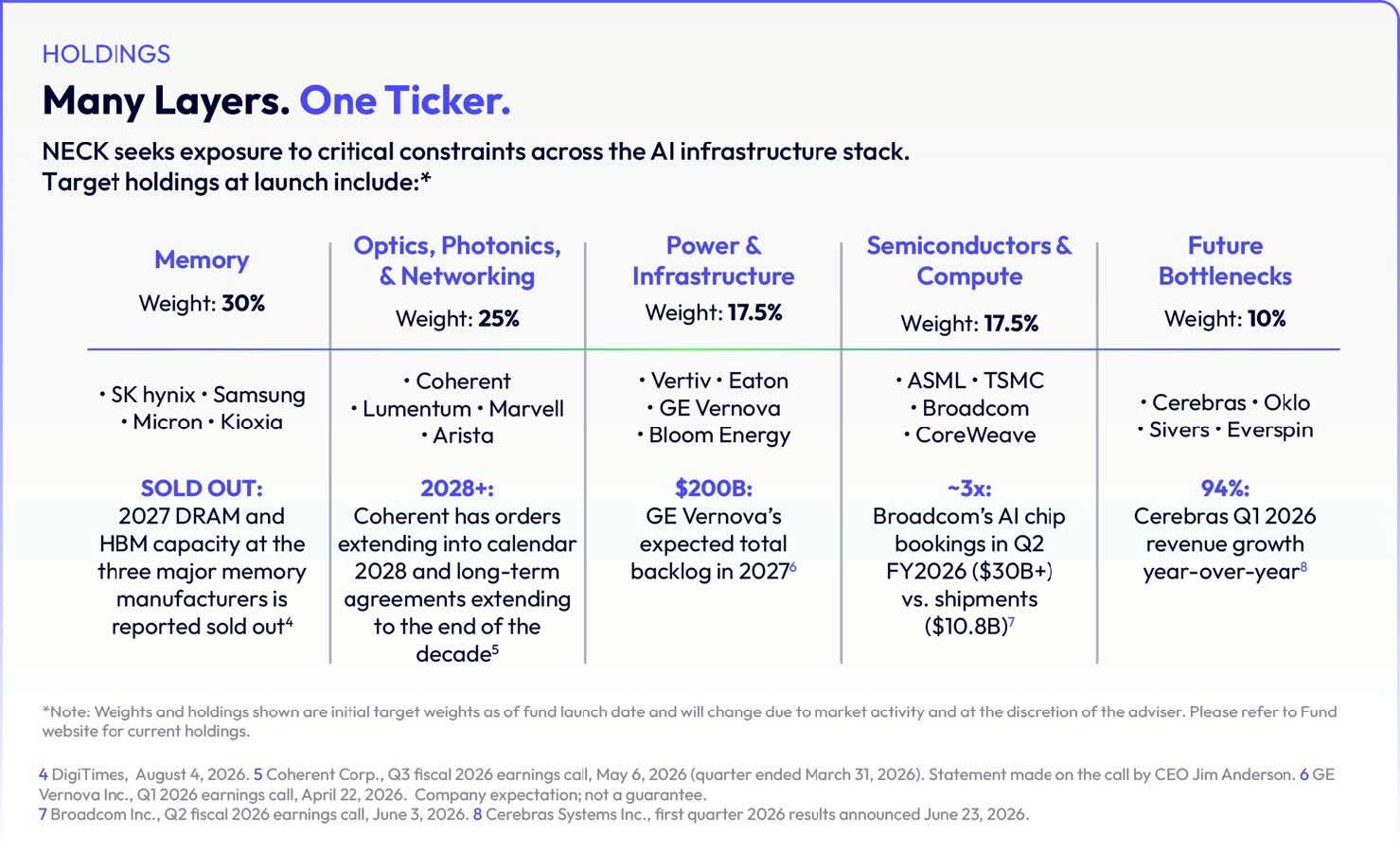
 

As bottlenecks ease, migrate, or emerge across the AI stack, the Fund expects to periodically rebalance its investments to reflect changing market conditions.
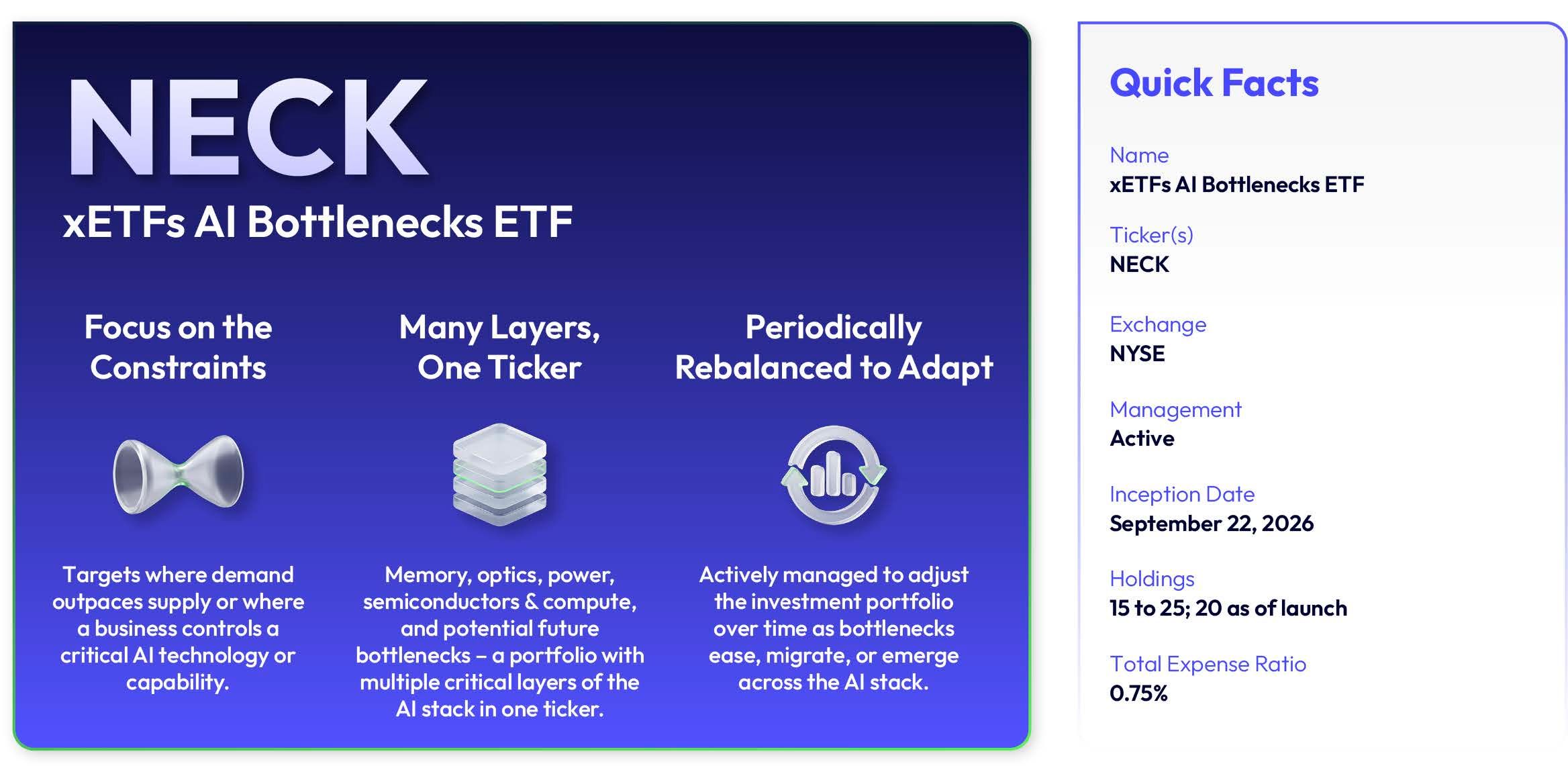
 

Targeting AI’s Critical Constraints.

Broad AI exposure tends to concentrate in the same handful of names. NECK is built around a different question: what companies supply the critical inputs that AI cannot scale without?


Learn more and view the prospectus at www.xETFs.com/NECK


Sources

1 Eaton Corporation plc management, Q2 2026 earnings call, July 31, 2026.

2 GE Vernova Inc., Q1 2026 earnings call, April 22, 2026.

3 SK hynix CEO Kwak Noh-Jung, quoted by Reuters, July 10, 2026. Company forecast; not a guarantee of future results.

4 LightCounting Research, Quarterly Market Update, June 2026. 5 Broadcom Inc., Q2 fiscal 2026 earnings call, June 3, 2026.

< Back

Carefully consider the Funds’ investment objectives, risk factors, charges and expenses before investing. This and additional information can be found in the Funds’ Prospectus and Summary Prospectus, which may be obtained by visiting https://funds.xETFs.com/investor-materials. Read the Prospectus and Summary Prospectus carefully before investing.

Exchange Traded Concepts, LLC serves as the investment adviser. WallStreetX ETFs, Inc. dba xETFs serves as the sub-adviser. The Funds are distributed by Foreside Fund Services, LLC., which is not affiliated with xETFs, Exchange Traded Concepts, LLC, or any of its affiliates.

Investing involves risk, including possible loss of principal. The Fund’s return may not match or achieve a high degree of correlation with the return of the Index. To the extent the Fund’s investments are concentrated in or have significant exposure to a particular issuer, industry or group of industries, or asset class, the Fund may be more vulnerable to adverse events affecting such issuer, industry or group of industries, or asset class than if the Fund’s investments were more broadly diversified. Issuer-specific events, including changes in the financial condition of an issuer, can have a negative impact on the value of the Fund.

A new or smaller fund is subject to the risk that its performance may not represent how the fund is expected to or may perform in the long term. In addition, new funds have limited operating histories for investors to evaluate and new and smaller funds may not attract sufficient assets to achieve investment and trading efficiencies.

Shares are bought and sold at market price (closing price) not net asset value (NAV) and are not individually redeemed from the Fund. Market price returns are based on the midpoint of the bid/ask spread at 4:00pm Eastern Time (when NAV is normally determined) and do not represent the return you would receive if you traded at other times. Brokerage commissions will reduce returns.

Covered Call Strategy Risk. A covered call strategy involves writing (selling) covered call options in return for the receipt of premiums. By employing this strategy, each Fund’s upside participation is capped, meaning investors will not benefit from increases in the underlying reference asset above the exercise price of the options. However, investors remain exposed to the full downside risk, as the Fund continues to bear the risk of underlying reference asset price declines. The premiums received from the options may not be sufficient to offset any losses sustained from underlying reference asset price declines over time. In rapidly rising markets, the Fund may significantly underperform the underlying reference asset, as gains above the exercise price are forfeited. As a result, the risks associated with writing covered call options may be similar to the risks associated with writing put options. Exchanges may suspend the trading of options during periods of abnormal market volatility. Suspension of trading may mean that an option seller is unable to sell options at a time that may be desirable or advantageous to do so.

Derivatives Risk. The use of derivative instruments involves risks different from, or possibly greater than, the risks associated with investing directly in securities and other traditional investments. These risks include: (i) the risk that the counterparty to a derivative transaction may not fulfill its contractual obligations; (ii) risk of mispricing or improper valuation; and (iii) the risk that changes in the value of the derivative may not correlate perfectly with the underlying asset. Derivative prices are highly volatile and may fluctuate substantially during a short period of time. Such prices are influenced by numerous factors that affect the markets, including, but not limited to: changing supply and demand relationships; government programs and policies; national and international political and economic events, changes in interest rates, inflation and deflation and changes in supply and demand relationships. Trading derivative instruments involves risks different from, or possibly greater than, the risks associated with investing directly in securities. Derivative contracts ordinarily have leverage inherent in their terms. The low margin deposits normally required in trading derivatives, including futures contracts, permit a high degree of leverage. Accordingly, a relatively small price movement may result in an immediate and substantial loss. The use of leverage may also cause the Fund to liquidate portfolio positions when it would not be advantageous to do so in order to satisfy its obligations or to meet collateral segregation requirements. The use of leveraged derivatives can magnify potential for gain or loss and, therefore, amplify the effects of market volatility on share price.

There is no guarantee that the Fund will be successful in its attempt to pay weekly distributions, which are not guaranteed and may be modified or discontinued at any time. A distribution may consist of a return of capital, ordinary income, qualified dividend income, and /or capital gains. A return of capital is a distribution that exceeds the Fund’s current and accumulated earnings and profits and is not taxable as current income. Instead, it reduces an investor’s tax basis in their shares and may result in a higher capital gain or lower capital loss when the shares are sold.

There is no guarantee that the Fund’s investment strategy will be properly implemented, and an investor may lose some or all of its investment. There is no guarantee that the Fund will be successful in its attempt to pay weekly distributions or consistent exposure to NVDA or TSLA. An investment in the Fund is not an investment in NVDA or TSLA. The Fund’s strategy will not capture all potential gains if NVDA’s or TSLA’s share price increases in value. The Fund’s strategy is subject to all potential losses if NVDA’s or TSLA’s share price decreases in value, which may not be offset by premium income received by the Fund.