
xETFs Daily Income ETFs are built differently than most covered call ETFs. That's intentional. And the most important difference comes down to one word: daily.
Here's what that means in practice, and why we think it matters.
What Traditional Covered Call ETFs Typically Do
Traditional covered call ETFs sell options on a large portion of their portfolio — often 100% — once a month. In exchange for a premium payment upfront, they cap the fund's equity upside for that entire option period.
That means if NVIDIA surges above the cap in a single week, a traditional covered call fund likely misses most of it. The cap is in place the whole month: through earnings, news events, and weekend gaps.
For investors who want income and equity exposure, that's a tough trade-off.
What Daily Income ETFs Do Differently
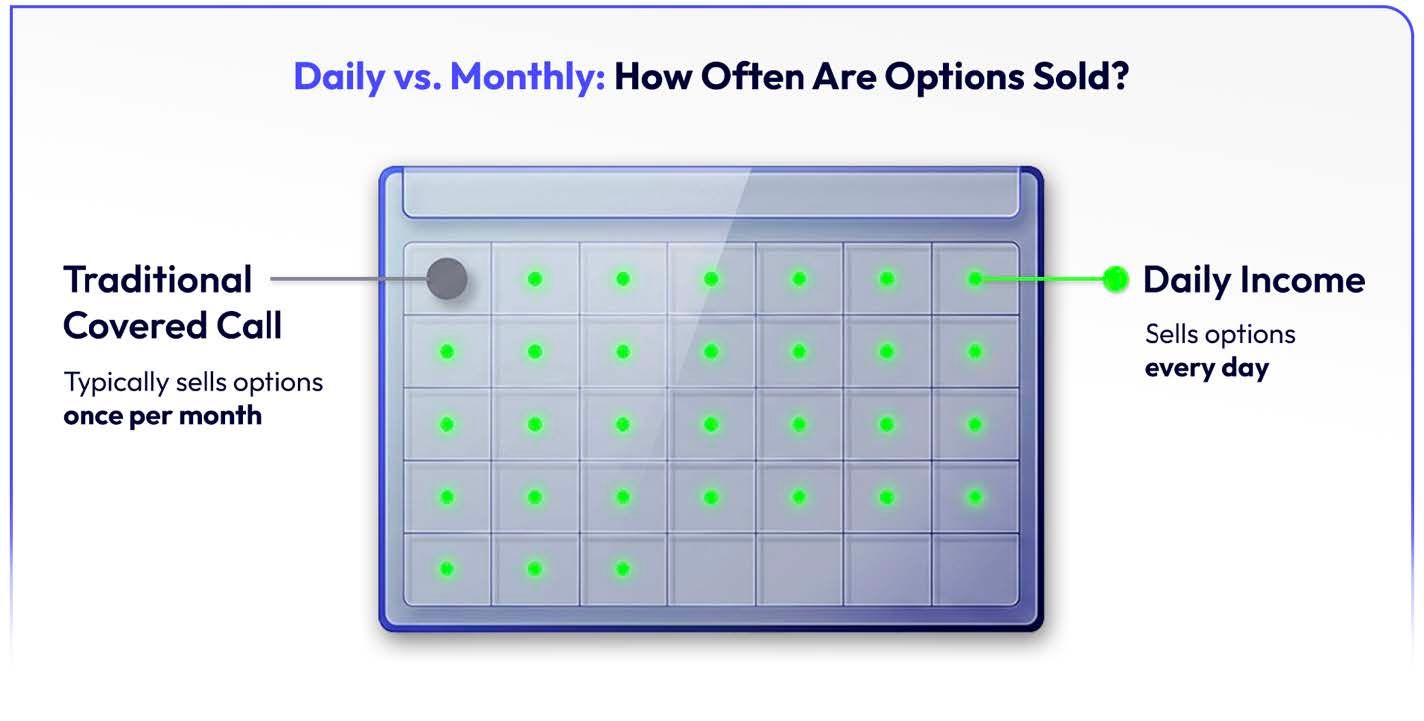
The xETFs NVDA Daily Income ETF (NYYY) and xETFs TSLA Daily Income ETF (TYYY) follow a systematic daily options strategy. Each trading day, the funds sell short-dated call options (typically 1 week or less) on up to 25% of stock exposure, with a target of 10%.1 Then those options are repurchased near the end of the trading day.
That daily cycle has three meaningful effects.
1. Short-dated options lose value the fastest
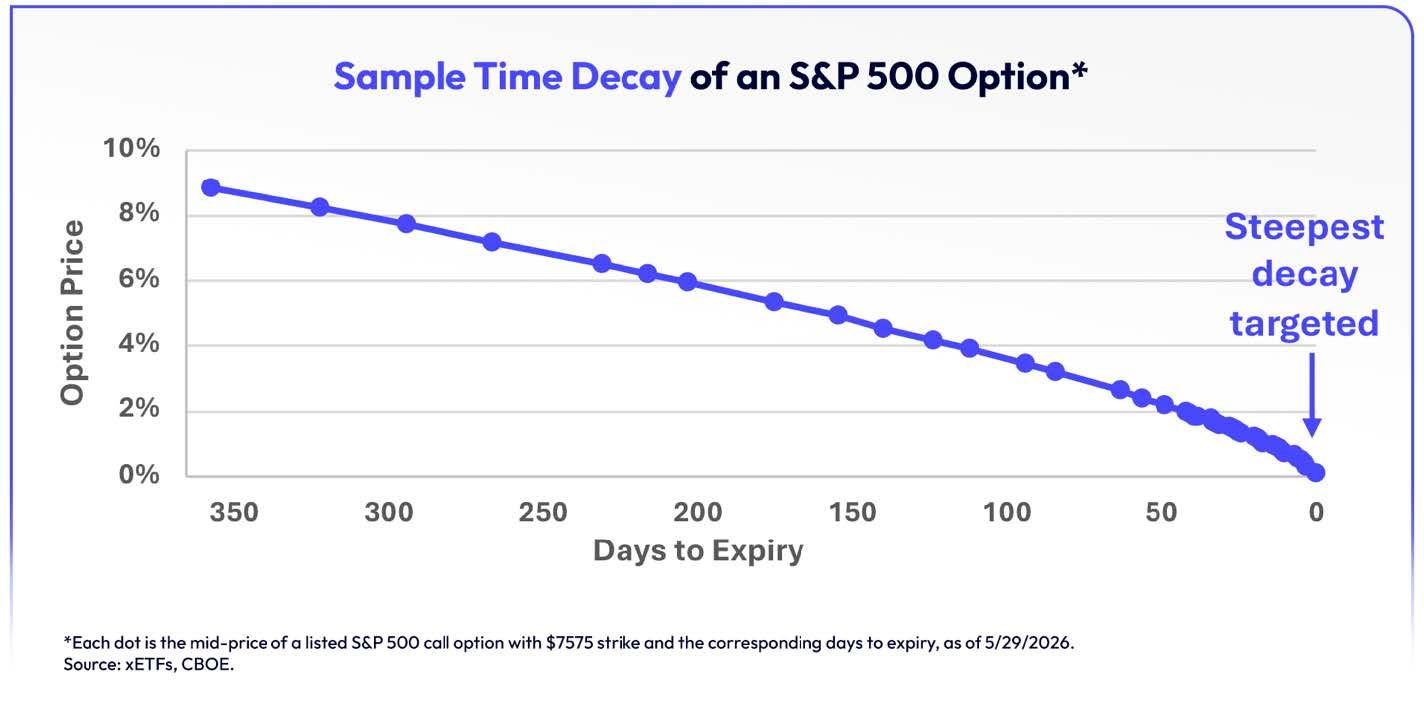
There's a concept in options called time decay, or theta. Options lose value as they approach expiration, but that decay isn't linear. It accelerates dramatically in the final hours and days before an option expires.
By selling short-dated options daily, we're targeting this steep part of the decay curve every single session, seeking to potentially generate more premium over the same period than a single longerdated monthly option would provide.
2. Retain majority of upside
Because the strategy sells options on a target of 10% of stock exposure (not 100%) it seeks to retain 90% stock upside participation for shareholders.
Compare that to a traditional covered call ETF, which overwrites 100% of the portfolio. If TSLA has a big day, shareholders in a traditional covered call fund see very little of it. With TYYY, the structure aims to keep most of that move.
3. No overnight cap
Some of a stock’s largest moves can happen after the market closes: earnings results, analyst notes, macro events, global market moves.
Because options are repurchased near the end of each trading day, the fund aims to remain fully exposed to the stock overnight and through the weekend. A monthly covered call strategy keeps its cap in place through all of that.
How The Daily Cycle Works
Each trading day follows the same systematic process:
- At open: the fund seeks equity exposure to NVIDIA (for NYYY) or Tesla (for TYYY) through stock or derivatives.
- During the day: short-dated call options (typically 1 week or less) are sold on up to 25% of stock exposure with a target of 10%, seeking to generate daily potential income.
- Near the close: options are repurchased, restoring full equity exposure for the overnight period.
- Weekly: net premium2 collected through this process seeks to contribute to weekly distributions to shareholders.3
Who Might This Make Sense For?
The xETFs Daily Income ETFs may be worth considering for investors exploring:
- Income enhancement in addition to equity exposure in NVIDIA or Tesla
- Distributions beyond traditional bonds
- A way to systematically seek to convert volatility into potential income
- A differentiated approach to covered call strategies that seeks income without fully capping upside
The Bottom Line
Most income ETFs treat selling options as a monthly event. We introduced the Daily Income strategy not just because it seeks to collect premium more frequently, but because of what it means structurally: targeting steeper time decay, retaining majority equity upside, and maintaining full overnight exposure to two of the most closely watched stocks in the market.
NYYY and TYYY are built around that idea. All investor materials including the fund prospectus are available at xETFs.com/investor-materials.
Sources:
1 Target as of June 15, 2026
2 Options trades will incur trading costs which will reduce net proceeds and net profitability of strategy. There is no guarantee that the Fund's investment strategy will be properly implemented, and an investor may lose some or all of their investment.
3 A portion of the weekly distributions will likely be characterized as return of capital. Return of capital represents a return of a portion of a Fund shareholder’s invested capital and is not the equivalent of dividend yield. Return of capital distributions will reduce an investor’s cost basis and may result in higher capital gains upon sale. There is no guarantee that the fund will pay distributions in the future, if any, and the current distribution may vary.